Using 75
Ohms lines to feed 50
Ohms antennas...
By Miguel R. Ghezzi (LU 6ETJ)
(To correctly read this
article you must have installed the
"Symbol" font )
During whole nights in a VHF frequency frequented by some friends interested in the radio techniques, I had opportunity
to heard the hard efforts to elucidate "how's and reason's" of using a
good 75 W coaxial CATV cable (obtained to
very low prices) for feeding 50 W antenna systems.
My good friend Gustavo LW9EJP who it is an enthuasias
ham, in their intents to get answers for his questions during months,
received all type of answers, but none
that conformed their desire to understand the reasons for the "yes's or
not's". Although, in general all friends coincided in that there would
not be bigger problems using it, the "yes" seemed more a solution
of commitment and "not's" left wide doubt margins in mind of Gus...
I made hard efforts in that geste that extended
along the months until finally Gus was fully convinced. This made me think it would be good to explain those
"minimum enough reasons" to
other colleagues having identical doubts.
|
What SWR will have a 75 Ohms
coaxil feeding an 50 Ohms antenna? |
Well, the formula of SWR in function of the
load and line impedances is:
SWR = ZL / Zo o Zo /
ZL (the one which result is bigger than 1), in our case
SWR = 75 W /
50 W = 1,5: 1
|
Which is the relationship
between incident and reflected power for a SWR of 1,5:1? |
Pr / Pi = [(SWR - 1) / (SWR
+ 1)]2 = 0,5 / 2,5 =0,04 of where
Reflected power = 0,04 x Incident Power or, the same thing, reflected power will be 4% of
incident power.
|
What loss will have when
using 75 Ohms line with 50 Ohms antenna ? |
|
Is dependent of how much loss would have the
line if it were worked with 1:1 SWR...
Let us suppose the line losses are 3 dB when is perfectly matched.
Graph
shows, for a 3 dB loss perfect match antenna-line system, from graph additional loss for 1,5:1 SWR will be
approximately 0,15 dB.
Having present that one "S" unit represents
6 dB; 0,15 dB will be 0,025 S. I don't know any "S meter" able to
solve 2,5 % "S" unit, neither any ham who be able to perceive so
minuscule difference on signals, then, as we can see, 75 W line it will be perfect for any use, even
the most demanding professionals applications.
|
 |
|
What will happen to
my transmitter working with this SWR on 75 line?
|
|
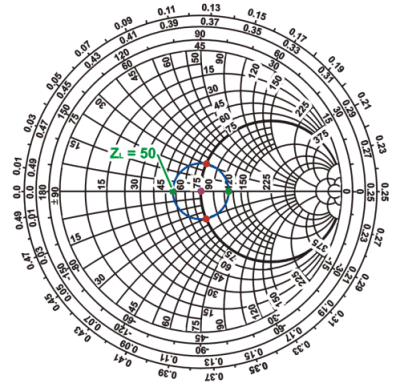
With 1,5: 1SWR, line will present to
transmitter an impedance that culd be 50 W, 112,5 W, 75± j30 W and other, all of them located on
the Gamma constant circle (blue color on to Smith chart),
depending on the line lenght.
If you cut the line to a exact multiple of 1/2 wave will obtain
at the transmitter line end exactly 50 Ohms that will offer a
perfect matching...
If the cable had an odd 1/4 wave multiple,
transmitter would see an 112,5 W impedance, different from that for which was designed. Any
rig should to work without troubles with this impedance but it would be possible that doesn't give
its maximum power, so
that it would more convenient to find the appropriate
line lenght.
|
 |
|
¿How I can find an appropriate
line lenght?
|
The first idea would be to
measure it, but this it won't be a very happy idea. To measure an hard line is a complicated task because difficultly we will be able to achieve that
you maintain perfectly right, even this way, we need to know very exactly
their phase speed since we know that a wave lenght in coaxil is not similar
to a wave lenght in free space. If there was a small discrepancy between
the foreseen value and the real one, you could obtain completely different results
from the espected.
More easy will be to make it bySWR meter.
Let us suppose for an instant that
transmitter line end impedance was 112,5W. If we connected this end to a 50W line, for this line those 112,5W they would be their load and according
that we have seen, SWR on 50 W line for a of 112,5 W load is:
SWR = 112,5 W /
50 W= 2,25:
1
This means that when we are going to cut the
75 W line
we
will measure its SWR value
first, possible readings will vary between 2,25 : 1 and 1 : 1. This way,
little by little, we will arrive to the wanted
match.
It is not necessary in the practice insert a 50 W line to interconnect to SWR meter. It will
really be enough connecting it directly to transmitter end of 75 W line (in fact we
are inserting an infinitely short
50 W line). Remember that we are
speaking about using an SWR meter designed for 50 W
lines.
|
But don't you wrote in some
article that to cut a line was an heresy ?
|
It is this way, but reading carefully will see that
we have said that: to trim a line doesn't make vary the it
SWR on its...
Indeed, the transmission line that
feeds the antenna is the 75W one, although we modify its lenght,
SWR on it will continue being 1,5 : 1...! But cutting a line like that, having
standing waves, will vary the impedance that presents on
their input terminals.
In our example there is not a line but really two, The 75 W one and the of 50 W one, We trim the 75W so that it
present a 50 W
impedance on some point (integers half wave
lenghts) and we use the 50 W
line (with the
SWR meter) to find which that point is. We will know it when SWR meter indicates
1 : 1.
Because "A thing, is a thing and another thing,
is another thing..."
You it can use, taking these few recaudos, a 75 W line
to feed any antenna, even at the highest frequencies. You can be sure will obtain
excelents results from the point of
view of a correct engineering technics and calm because about your equipment won't suffer
absolutely any damage.
73'S AND DX...
Miguel
References:
(1) King, Henry (W5 TRS),
"Ham notebook", Ham Radio. September 1975. pag 66
(2)Aylor, Raymond (W3 VDO),
"Comments", Ham Radio. May 1976. pag 63
(3) Carrol, Charles (K1 XX), "Matching
75-ohm CATV hardline to 50 ohm system", Ham Radio. September 1978. pag
31
Return to english
main page
Volver
a página principal en castellano