The wonderful Series -
Parallel transformation
By Miguel R. Ghezzi (LU 6ETJ -
Argentina)
www.solred.com.ar/lu6etj
SOLVEGJ Comunicaciones
www.solred.com.ar/solvegj
One of the most complicated areas for the Novice
amateur is related with impedance matching;
area that embraces question such as the one " Pi " of our old tube
transmitter, transmatch, adaptation between the stages of
those amplifiers and it is linked with the mysteries of the Hairpin of
our directional one.
As well as the laws of Ohm and Kirchoff, together with
the Thevenin and Norton's theorem allow to
solve a net or mesh easily, if we can to understand the simple Series - Parallel
transformation, we will be able to solve many usual situations on the
radio amateur activities, especially understanding how it
is that this works?.
Look the two circuits of the fig. 1. could you
measure impedance on terminals of each one?. Surely
that if. Now, then it would be possible that do both have the same value
of Impedance?. The answer is YES...
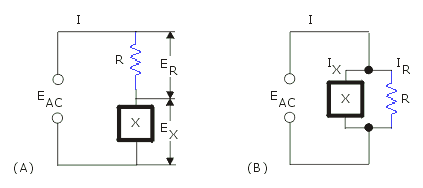
This means that circuit of the fig. has an homologous that is the one of the fig. B.
We can see that
although one is constituted by two series elements, the other
one has two elements in parallel, since both it has same impedance these circuits
are equivalent.
We will make an exception:
We know that
the Impedance of a circuit (unless it is purely resisitivo) it will
depend on the frequency, for this, when we made the mensuration we
carry out to a certain frequency. If we changed the frequency of
mensuration we would find that both no longer have
the same impedance, so that the circuits A and B are equivalent
on a
unique frequency.
The interesting thing is that with a couple
of formulas we will always be able to convert a circuit like that of the
fig. A in one as that of the fig. B and vice versa, and this it will be
very useful to understand the operation of numerous circuits for
impedances matching.
If we know the values of a
series circuit and we want to discover those equivalent parallel values
we will do with the following one:
Si conocemos los valores de un circuito serie y queremos averiguar los
valores equivalentes en paralelo empleamos la siguiente:
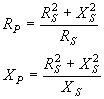 |
To get the parallel equivalent of two
series elements. |
If we know the values of a parallel circuit
and we want to discover those value equivalent in series we use this
other one:
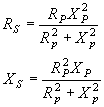 |
To get the equivalent serie
circuit of two elements in parallel.
|
A practical case:
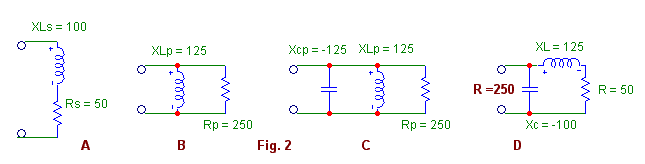
The circuit of fig. 2A contain one
resistance that "accidentally" it is 50 Ohms in series with one 100
Ohms inductive reactance. If we apply the formula it will
transform into the parallel circuit of the fig 2B. Now, our
equivalent circuit has a 250 Ohms resistance in parallel with a 125 Ohms
inductive reactance. What it would happen if we connect in parallel a -125
Ohms reactance capacitor to this
circuit?. Both reactancias, like we know, will cancel out, and it will be visible
only the 250 Ohms resistance. Notice
that the the inductor in the fig 2D remain physically in series, since
those of the figures B and C are only their equivalent
ones.
Do you realize that we have achieved? We are able to convert the 50 Ohms
resistance in one of 250 Ohms...! Is it or not a matching of impedances?".
This
matching net, one of
the simplest, is the "L" net. It has a great matching capacity, for example, if we
change the value of series inductance from 100 to 500 Ohms, the resistance equivalent parallel that
we would get it would be in order of 5000 Ohms, with it we would
very easily adapt an end fed half wave dipole to a
50 Ohms line.
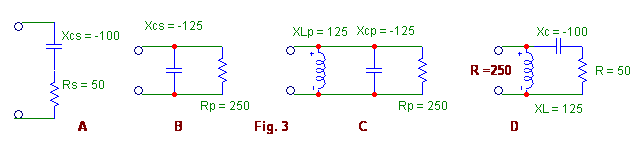
Let us see now what it happens if we connect a series
capacitor whose
reactancia is -100 Ohms (that is to say the same as the reactancia of
the previous example, but capacitiva this time ) to the 50 Ohms resistance.
Nothing especial, except that now will have a parallel equivalent circuit
formed by a capacitor and a resistance. Canceling the
equivalent capacitive reactancia with an inductive of same value, again
we get a matching. It is also a "L" net, but, in this case, the element
in series is a capacitor and the element in derivation an
inductor.
Which is the difference among
them?
An important difference is that the "L" net with series
inductance and capacity in derivation have lowpass filter characteristics, this favors us if we want that
matching network helps to cancel harmonic radiations. On the contrary the one that
has as series element the capacitor and as element in derivation the
inductor, has higpass filter characteristic, fact that we can also take
advantage, for example, to avoid broadcasting band signals in the front
end amplifier receiver when it is operated in 160 or 80m.
Up to now we have connected to the 50 Ohms
resistance a capacitor or an inductor in
series and in both cases the resistance equivalent obtained it
was bigger than 50 Ohms achieving a " raise " impedance transformation. We could think
that connecting an element in
parallel to the 50 Ohms resistance and finding, this time, their
series equivalent, the
result would be the inverse one. It is right...! If we apply the formula,
we will see
that the series equivalent circuit for this circuit offers us a smaller
equivalent resistance.
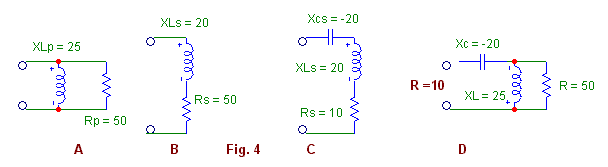
But if we look fig. 3D we see that
on 250 Ohms side, (high impedance side),
is the inductor in derivation and on low side impedance the series capacitor;
the same as in this example. Is enough obvious, then, we are in
front of a symmetrical behavior.
Common
applications
The first application that we are thinking is
just a transmatch, also the matching inter stage circuit of an amplifier, but an employment of this,
not so evident, is antennas matching by means of "Beta Match" also
well-known "Hairpin" match...
A several elements directional antenna, usually
have an impedance smaller than 50
Ohms on the excited element, and it is convenient to adapt it to
transmission line, that generally is 50 Ohms.
Hairpin or Beta Match
As we have seen in the example of the
figure 3A, if we connect a capacitor in series with one given resistance,
the parallel equivalent resistance increases. The
parallel capacitive reactance equivalent that is useful for the transformation
can be
canceled by an inductor achieving this way the wanted matching. Applying this notion to our problem, we see that:
An antenna whose longitude is smaller than necessary one for its
autoresonance it will present a capacitive component on its feeding point, then, intentionally
shortening the
excited element we produce an complex impedance similar to that
on figure 3A, so that their equivalent one parallel
have a 50 Ohms resistance. Canceling the capacitive reactance with
the corresponding inductor we get the match. The one "Hairpin" is not another thing that the inductor connected
in derivation to achieve the wanted effect, with that which we have
found another application not so evident of the "L" net.
Return to
english main page
Volver
a página principal en castellano